
Life insurance for families: protect your loved ones

TL;DR:
Nearly half of U.S. adults lack sufficient or any life insurance, leaving families vulnerable to financial ruin.
Most families underestimate their coverage needs, with recommended amounts being 10 to 15 times income, but average policies are much lower.
Choosing the right policy type and regularly reviewing coverage is essential for long-term family financial security.
Nearly half of American adults have no life insurance, leaving millions of families one unexpected tragedy away from financial ruin. And the families who do have coverage? Many are still dangerously underinsured. Most people assume a basic policy from work is enough, but employer coverage rarely keeps pace with a growing family’s actual needs. Mortgages, childcare, college tuition, and everyday expenses add up fast. This guide walks you through exactly how much coverage your family needs, which type of policy fits your situation, and what most families get wrong when they buy life insurance.
Table of Contents
Key Takeaways
Point | Details |
Coverage gap is huge | Most families have far less life insurance than they actually need, leaving loved ones at risk. |
Simple math guides protection | Aim for 10-15 times annual income, using frameworks like the DIME method for precise needs. |
Policy choice matters | Understanding term, whole life, and child policies helps families choose the best fit for unique situations. |
Custom plans for special cases | Single parents, stay-at-home parents, and smokers all have distinct needs that deserve tailored coverage. |
Expert help makes it easier | Partnering with a knowledgeable advisor simplifies getting the right policy and staying protected as needs change. |
Why life insurance matters for families
Let’s be honest about the stakes. If something happens to the person bringing in the family’s income, life insurance is what stands between your loved ones and financial collapse. It is not a luxury. It is a safety net that pays the mortgage, keeps the lights on, funds your child’s education, and gives your family time to grieve without financial panic.
The numbers paint a sobering picture. Only 51% of US adults own life insurance, leaving roughly 99 million Americans either under or uninsured. That means a majority of families are exposed to serious financial risk every single day.
Consider what happens when a breadwinner passes away without adequate coverage:
The surviving spouse may need to sell the family home to cover debt
College plans for children get delayed or abandoned entirely
Childcare costs become overwhelming on a single income
Everyday living expenses create mounting debt
Retirement savings get depleted years before they should be touched
“Life insurance is not about replacing someone you love. It is about making sure the people they love can keep living with dignity.”
Understanding how life insurance works gives families the confidence to stop putting off this conversation. The policy you buy today is the promise you make to your family about tomorrow.
Many families also underestimate how securing your family’s future goes beyond just having a policy. Choosing the right amount, the right type, and reviewing it regularly are all part of protecting insurance that matters most. Coverage is not a one-time checkbox. It is an ongoing commitment.
How much life insurance do families really need?
Once you know why coverage is so important, the natural next question is: how much is enough? Most families guess. And most families guess wrong.
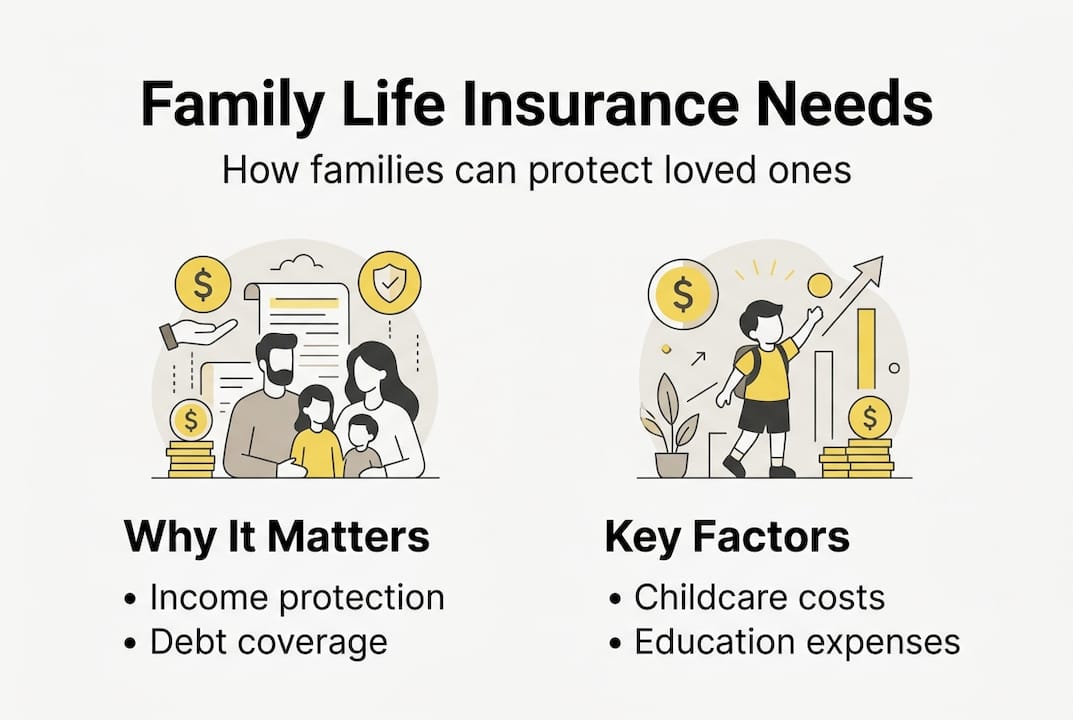
Recommended family coverage is 10 to 15 times annual income, yet the average American family carries only about 3.5 times their income in coverage. That gap is enormous, and it leaves families far short of what they actually need.
One of the best ways to get an accurate number is the DIME method. Here is how it works step by step:
Debt: Add up all outstanding debts except your mortgage (credit cards, car loans, student loans)
Income: Multiply your annual income by the number of years your family needs support (typically 10 to 15 years)
Mortgage: Add the remaining balance on your home loan
Education: Estimate college costs for each child (often $100,000 or more per child at today’s rates)
Pro Tip: Run the DIME method every two to three years, especially after major life events like a new baby, a home purchase, or a salary increase. Your coverage needs grow as your family grows.
Here is a quick comparison of what different income levels need versus what most families actually carry:
Annual income | Recommended coverage (10-15x) | Typical coverage (3.5x) | Coverage gap |
$50,000 | $500,000 to $750,000 | $175,000 | $325,000+ |
$75,000 | $750,000 to $1,125,000 | $262,500 | $487,500+ |
$100,000 | $1,000,000 to $1,500,000 | $350,000 | $650,000+ |
Childcare costs alone make a strong case for higher coverage. Families pay $17,000 or more per child per year for full-time childcare, and that number climbs every year. When you combine that with essential coverage assessment tools and insurance calculation tips, getting to a real number becomes much more manageable. Use the DIME method for families as a foundation, then adjust for your unique situation.

Types of life insurance policies for families
Setting the right amount of coverage is key, but so is picking the right policy for your family’s unique needs. There is no single answer that fits every household, but understanding your options makes the decision much clearer.
Term life insurance covers you for a set period, usually 10, 20, or 30 years. Premiums are lower, which makes it the most popular choice for young families with dependents and a tight budget. If you die during the term, your beneficiaries receive the death benefit. If you outlive the policy, coverage ends.
Whole life insurance covers you for your entire life. Premiums are higher, but the policy builds cash value over time that you can borrow against. It is a stronger fit for families who want lifelong coverage or are looking for a secondary savings vehicle.
Here is how the two main options stack up:
Feature | Term life | Whole life |
Premium cost | Lower | Higher |
Coverage period | Set term (10-30 years) | Lifetime |
Cash value | No | Yes |
Best for | Young families, budget-conscious | Long-term security, estate planning |
Average new policy | Varies | Often $206,000 or more |
Average new family policies sit around $206,000, which is frequently insufficient for families with children when you factor in education and income replacement. Explore term life basics to understand how flexible this option can be.
Child life insurance policies are another option families ask about. The main argument for them is locking in a low premium rate while the child is young and healthy. The argument against is that children rarely have dependents who rely on their income, so the core reason to buy life insurance does not apply. Many financial planners suggest a 529 college savings plan as a better tool for building your child’s financial future. Review policy features explained and compare policy options to see what aligns with your goals.
Term life: Best for most families during peak earning and child-raising years
Whole life: Best for long-term estate planning and lifelong dependents
Child policies: Worth discussing with an advisor, but not always the first priority
Special considerations: Single parents, stay-at-home parents, and smokers
In addition to those basics, some family situations call for more specialized planning. The standard advice does not always fit, and certain groups face challenges that deserve direct attention.
Single parents carry the full financial weight of the household. If they pass away, there is no second income to absorb the shock. Single parents often need higher income replacement, and they should also factor in legal guardianship arrangements when planning. A policy that covers both income replacement and childcare costs for the duration of a child’s upbringing is essential coverage for every family type.
Stay-at-home parents are frequently overlooked in life insurance planning, which is a serious mistake. Their work, including childcare, cooking, transportation, household management, and emotional support, carries a replacement value of $250,000 or more. If a stay-at-home parent passes away, the surviving working parent must pay for all of that out of pocket, often while grieving.
Pro Tip: When calculating coverage for a stay-at-home parent, research the actual cost of full-time childcare, housekeeping, and meal services in your area. The total often surprises families.
Smokers can absolutely get life insurance, but they need to plan for the added cost. Smokers pay two to four times more in premiums than non-smokers. That is a significant difference, but it does not mean coverage is out of reach. It means budgeting carefully and shopping around for competitive rates.
Key points for special situations:
Single parents should include guardianship costs in their coverage calculation
Stay-at-home parent coverage is just as important as the breadwinner’s policy
Smokers should compare multiple carriers for the best available rate
Quitting smoking for 12 months can often qualify you for better rates; ask your agent
For child policies, review the child policy debate before deciding
Our perspective: Why most families still get life insurance wrong
Now that you have the foundational facts, let’s challenge the conventional wisdom. At Strawderman Financial, we see the same pattern repeat itself constantly. Families buy a policy, feel relieved, and then never look at it again. Years later, they have more debt, more children, a bigger mortgage, and the same $250,000 policy they bought in their twenties.
The 10x rule is a starting point, not a finish line. Generic online calculators rarely account for blended families, a child with special needs, a spouse returning to school, or a business interest that needs protection. Real planning requires real conversation.
Life also changes fast. A review you skip after buying a new home could leave your family $200,000 short if something happens. We believe the families who build genuine security are the ones who treat life insurance as a living plan, not a one-time purchase. That means revisiting your coverage every few years and after any major life event. A deeper look at life insurance can reveal gaps you never knew existed. Personalized planning is not just about peace of mind. It is the difference between your family keeping their home or not.
Get guidance: Protect your family’s future with expert support
You have done the hard part by learning what your family truly needs. Now it is time to put that knowledge into action with the right support behind you.

At Strawderman Financial, we work with families across the United States to find life insurance options that fit their real lives, not just a generic formula. Whether you are a single parent, a two-income household, or somewhere in between, our agents help you cut through the confusion and get coverage that actually protects the people you love. We also offer full-service planning that connects your insurance coverage to your broader financial goals. Schedule a free consultation today and walk away with a clear, confident plan.
Frequently asked questions
What is the best type of life insurance for families?
Term policies are the most affordable option for families with dependents, though whole life may be better for those who want lifelong coverage and a cash value component.
How much life insurance should a family get?
Most families should target 10 to 15 times their annual income, factoring in debts, childcare costs, and education expenses to reach a number that truly covers their needs.
Do stay-at-home parents need life insurance?
Absolutely. Replacing the childcare and household duties a stay-at-home parent provides can cost over $250,000, making coverage essential for family stability.
Can you get life insurance if you smoke?
Yes, but smokers typically pay two to four times higher premiums than non-smokers, reflecting the additional health risk carriers take on.
Is it a good idea to buy life insurance for children?
Experts are divided. While locking in low rates early has appeal, the child policy debate suggests 529 college savings plans may deliver better financial value for most families.
Recommended


Comments