
How to choose vision insurance: step-by-step guide

TL;DR:
Vision insurance helps make routine eye care more predictable and affordable for families.
Comparing plans requires understanding coverage, provider networks, costs, and exclusions to find the best fit.
Choosing the right plan involves modeling total annual costs and verifying providers are in-network before enrolling.
Imagine sitting at the optometrist’s front desk, and the receptionist slides a bill across the counter for $380. No insurance. Your child’s first pair of glasses plus an eye exam just wiped out your grocery budget for two weeks. It happens more often than most families expect, and it almost always catches people off guard. The right vision insurance plan can make eye care predictable and affordable, but only if you know how to pick one that actually fits your household. This guide walks you through every step, from understanding basic plan types to finalizing a choice you can feel confident about.
Table of Contents
Key Takeaways
Point | Details |
Know your needs | Assess your family’s eye care requirements and usage to choose the right insurance plan. |
Compare plan types | Understand the difference between HMO, PPO/POS, and Indemnity plans before making a decision. |
Total cost matters | Look at premiums, copays, and upgrade costs—don’t just pick the lowest monthly rate. |
In-network saves money | Confirm your preferred providers are covered to maximize benefits and minimize costs. |
Understanding vision insurance basics
Vision insurance is not the same as health insurance. It is a separate, focused benefit designed to offset the cost of routine eye care, including exams, frames, lenses, and sometimes contact lenses. Think of it as a budgeting tool. You pay a predictable monthly amount, and in return, the plan covers a portion of your expected eye care costs.
There are three main plan types you will encounter:
HMO (Health Maintenance Organization): The most affordable option, but you must use providers within a set network. No out-of-network benefits.
PPO/POS (Preferred Provider Organization/Point of Service): More flexible. You can see providers outside the network, but you will pay more. Premiums are higher than HMOs.
Indemnity plans: You can visit any provider, then submit a claim for reimbursement. Maximum flexibility, but also the highest out-of-pocket risk.
Before you compare anything, make sure you understand a few key terms. The premium is what you pay monthly, regardless of use. A copay is your fixed cost per visit or service. A deductible is what you pay before benefits kick in. The allowance is the plan’s maximum contribution toward frames or lenses, typically between $100 and $250. Most plans also set frequency limits, meaning they will only cover one exam every 12 or 24 months.
Standard vision plans generally cover annual eye exams, basic frames, standard lenses, and sometimes contact lenses in place of glasses. What they commonly exclude: laser surgery, specialty contact lenses, and medical treatment for conditions like glaucoma or macular degeneration. Those typically fall under your regular health insurance.
This is a crucial distinction. Vision insurance handles routine care. When an eye issue becomes a medical problem, your types of health insurance coverage steps in. Both work together, but they are not interchangeable.
“A vision plan is not meant to cover everything. Its job is to make routine care affordable and remove the barrier that keeps people from getting annual exams.”
Pro Tip: Always ask whether a plan covers “eye exams” or “medical eye care.” Routine exam coverage and medical eye care coverage are handled by different benefit structures and sometimes different insurance types entirely.
Preparing to compare plans: What to gather
With the basics covered, your next step is to get organized before you start comparing plans. Jumping straight into quotes without knowing your household’s needs is a fast way to overpay or underinsure.
Start by listing every person in your household who needs coverage. Note their vision history. Does anyone wear glasses or contacts? Has anyone had recent changes in prescription? Do any family members have a history of eye conditions? These answers directly affect which plan delivers real value versus which one just sounds good on paper.

Next, identify the eye care providers your family already trusts. Switching doctors is a hassle, and some families have built relationships with specific optometrists for years. Networks vary widely. For example, VSP covers 39,000+ doctors nationally, while smaller carriers may have limited local access. Always confirm your preferred doctor is in-network before you enroll. Out-of-network reimbursements are lower, sometimes significantly so.
Here is a simple table to help organize your household’s vision data before shopping:
Family member | Glasses/contacts | Current provider | Exam frequency | Anticipated needs |
Parent 1 | Glasses | Dr. Patel | Annual | New frames, lenses |
Parent 2 | Contacts | Dr. Lee | Annual | Contact lens supply |
Child 1 | Glasses | Dr. Patel | Annual | Prescription update |
Child 2 | None | None | Baseline exam | First exam |
Once you have that picture, list out what you realistically expect to use in the next 12 months. New frames? A contact lens supply? Prescription sunglasses? This shapes your cost modeling later. Following structured health insurance selection steps before you shop prevents you from missing critical criteria.
Pro Tip: Build a short checklist before you start requesting quotes. Include: household members, their providers, expected services, and your monthly budget. This takes 10 minutes and saves hours of confusion during the comparison process.
Step-by-step: How to compare vision insurance plans
With your requirements in hand, it’s time to start shopping and critically evaluating plans. Do not rely on a single carrier quote. Gather at least three to four options before drawing any conclusions.
Here is a reliable process for comparison:
Request quotes using your ZIP code. Most carriers have online tools that show available plans and in-network providers by location. Use them.
Read the Summary of Benefits for each plan. Do not just scan the premium. Look at what each plan actually covers, and more importantly, what it excludes.
Confirm your preferred doctors are in-network. Call the provider’s office directly if the online directory seems outdated.
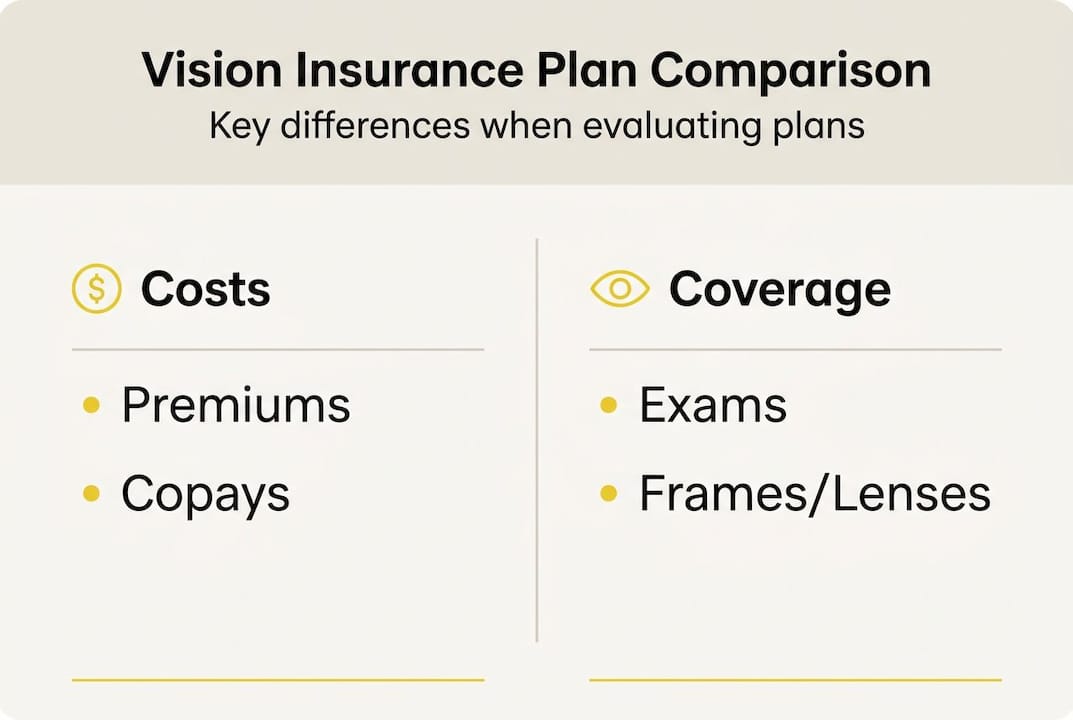
Model your total annual cost. Add up the premium multiplied by 12, plus expected copays and any upgrade costs. Upgrades like progressive lenses or anti-reflective coatings are common overages that add real cost beyond the standard allowance.
Check exclusions carefully. Some plans exclude certain lens treatments, brand-name frames, or specific contact lens types.
Review plan ratings and member feedback. NCQA ratings and online reviews can surface quality and service problems that premiums alone will not reveal.
Here is a side-by-side example of how plan features might compare:
Feature | Plan A (HMO) | Plan B (PPO) | Plan C (Indemnity) |
Monthly premium | $16 | $30 | $38 |
Exam copay | $10 | $15 | $0 (reimburse) |
Frame allowance | $130 | $200 | $250 |
Lens upgrade coverage | Limited | Partial | Full reimburse |
Out-of-network | None | Yes (reduced) | Yes (full) |
Exam frequency | 12 months | 12 months | 12 months |
And consider this: bundling dental and vision insurance with a single carrier often reduces your overall premium. If you are already shopping for compare insurance policies across multiple lines, ask carriers about combined plan discounts.
Pro Tip: Never compare just monthly premiums. A $16 per month plan that leaves you paying $180 out of pocket for lenses costs more annually than a $30 per month plan with full lens coverage.
Verifying the best fit and finalizing your decision
Once you’ve compared the options, it’s important to validate your choice before you enroll. One common mistake is assuming the plan you modeled is the one you will actually use. Verify every detail before you commit.
Here is a final verification checklist to run through:
Confirm your providers are in-network using the carrier’s most current directory, not a third-party listing.
Recalculate your total annual cost including premiums, expected copays, and any anticipated overage charges for upgrades.
Check the plan’s frequency limits to make sure they match your household’s exam schedule.
Read exclusions one more time, paying attention to contact lens coverage, specialty lenses, and any medical eye care limits.
Look up the plan’s ratings or member reviews for service quality and claims handling.
Ask your employer or professional association if they offer a subsidized group vision plan. Employer-subsidized plans are often the most cost-effective option available.
If you have any history of eye conditions or other health concerns, check how the plan handles pre-existing conditions and insurance coordination, particularly for ongoing treatment needs.
“Regular eye exams do more than update your prescription. They can detect early signs of diabetes, high blood pressure, and other systemic conditions before other symptoms appear. The right vision plan makes those exams routine, not optional.”
Once your checklist is clear, enrollment is straightforward. Most carriers allow online enrollment, or you can work with an agent who can walk you through the process. You can always browse more insurance tips to stay informed across all your coverage decisions.
What most people miss when choosing vision insurance
Most people treat vision insurance like a cable package: pick the cheapest one that sounds good and move on. That mindset costs families real money.
Here is what we have seen time and again: the monthly premium gets all the attention, but the real value lies in whether the plan actually serves your household’s usage patterns. A plan with a $130 frame allowance looks fine until you realize your family prefers mid-range frames that regularly exceed that amount.
More importantly, annual eye exams are one of the most underrated forms of preventive care available. Skipping them because your current plan makes them inconvenient or expensive is a short-term savings that can become a long-term cost. Conditions caught early cost far less to treat.
Also, most buyers ignore plan quality ratings entirely. A plan with a slightly higher premium but strong provider access and clear claims handling is almost always worth more than a cheap plan that fights you at every step. Following smart steps for health insurance selection applies just as well to vision coverage as it does to major medical.
Pro Tip: Before finalizing any plan, ask specifically how it handles upgrades like progressive lenses and specialty coatings. These are where most policyholders get surprised by out-of-pocket bills that the plan summary never made obvious.
Get expert help with your coverage options
If you’re unsure or want extra peace of mind, you don’t have to navigate these choices alone. Selecting the right vision plan is just one piece of a larger coverage picture, and getting it wrong can mean paying more than you need to for years.

At Strawderman Financial, we help families across the U.S. find health insurance options that fit their real lives, not just their budgets. Our agents also work with clients on life and health plans, dental and vision bundles, and retirement planning so nothing falls through the cracks. A single consultation can reveal savings opportunities and gaps you may not have noticed on your own. Speak to a local expert at Strawderman Financial today and get the clarity your family deserves.
Frequently asked questions
What is typically covered by vision insurance?
Vision insurance usually covers annual eye exams, frames, and lenses, but coverage for contacts, specialty lenses, and procedures varies by plan. Always review the Summary of Benefits before enrolling.
How much does vision insurance cost on average?
Most plans fall within $16 to $38 per month, plus potential copays and frame or lens upgrade costs that can add up quickly if you choose higher-end options.
Is using an employer or group plan cheaper than individual vision insurance?
Employer and association plans are often less expensive due to group rates and subsidies, making them the first option worth exploring before buying individual coverage.
What are the biggest mistakes when choosing vision insurance?
Ignoring network access, underestimating total yearly costs, and missing plan exclusions are the most common errors. Always model total annual cost including copays and upgrade overages, not just the monthly premium.
How do I find if my eye doctor is covered in a vision plan?
Check the carrier’s latest provider directory or use in-network search tools on the plan’s website before you enroll to avoid out-of-network costs.
Recommended


Comments