
Build a Family Insurance Planning Workflow for Security

TL;DR:
Families often discover coverage gaps too late due to unexpected life events, but a structured review can prevent crises. Using the comprehensive H.E.L.P. approach, including tools like the DIME method, helps households accurately assess and update their insurance needs regularly. Consistent organization, annual reviews, and professional guidance ensure families maintain an effective insurance strategy tailored to their evolving circumstances.
Many families only discover their coverage gaps when it’s too late. A sudden illness, an unexpected death, or a job loss can expose weaknesses in a plan that seemed solid on paper. The good news is that a structured workflow, built around proven calculation methods and regular review habits, can close those gaps before they become emergencies. This article walks you through every stage of that process, from understanding what insurance types your household needs, to calculating life insurance using the industry standard DIME worksheet method, to avoiding the mistakes that catch even careful families off guard.
Table of Contents
Key Takeaways
Point | Details |
Use a structured workflow | A multi-step approach prevents gaps and keeps your insurance aligned with your family’s needs. |
DIME for life insurance | Add up debts, income replacement, mortgage, and education costs to estimate proper life coverage. |
Don’t chase low premiums | Compare total health plan costs, including deductibles and network coverage, not just monthly price. |
Annual review is essential | Reassess coverage each year and after life changes to ensure your plan remains relevant. |
Stay organized | Keep key insurance documents handy and update them regularly for efficient, stress-free planning. |
Assessing your family’s insurance needs
Once you understand the importance of a holistic approach, the next step is knowing what coverage you need and what you already have. Most families focus on health insurance because it’s required and visible, but a truly resilient plan includes several other layers of protection working together.
The table below summarizes the major personal insurance categories every family should evaluate:
Insurance type | Primary purpose | Typical need |
Health insurance | Cover medical bills and preventive care | All family members |
Life insurance | Replace lost income and cover debts | Primary earners, stay-at-home parents |
Disability insurance | Replace income if you can’t work | All working adults |
Homeowners/Renters | Protect property and liability | All households |
Auto insurance | Cover vehicles and injury liability | All licensed drivers |
Supplemental (critical illness, dental, vision) | Bridge gaps in primary coverage | Households with health cost exposure |
Understanding life insurance basics helps you see why life coverage is often the most complex piece to size correctly. The same is true for types of health insurance, where the range of plan structures can make comparison feel overwhelming.
For life insurance specifically, the DIME method is the worksheet approach most financial professionals recommend. DIME stands for:
D = Debts (credit cards, car loans, personal loans)
I = Income replacement (annual income multiplied by years until retirement)
M = Mortgage (total payoff balance)
E = Education and everything else (tuition estimates, child care, final expenses)
You add those four numbers together to reach a coverage target. This is far more precise than simply multiplying your salary by a round number, because it accounts for your actual household obligations rather than a generic estimate.
Before sitting down to calculate anything, gather the following details:
Number of dependents and their current ages
Gross household income for each earner
Total outstanding debts, not counting the mortgage
Current mortgage payoff balance
Estimated college costs for each child
Existing coverage through employer benefit plans
Current life, disability, and supplemental policy face amounts
Pro Tip: If both spouses have coverage through separate employers, compare the plans carefully. Duplicate coverage might seem like extra security, but it can create billing complications, and you may be paying premiums for benefits you can’t double-collect on. Consolidating often saves money without sacrificing protection.
Collecting and organizing essential information
With your needs outlined, the next crucial task is organizing all the details that fuel sound decisions. Many families have insurance policies scattered across HR portals, email inboxes, and physical files. Pulling everything into one place takes an afternoon but saves countless hours later.
Work through this ordered checklist to collect what you need:
Gather all current insurance policies, including the declaration pages that show coverage limits, deductibles, and premium amounts.
Download or print the latest statements for each policy, noting the renewal dates and any pending changes.
Log into each insurance company portal and confirm that beneficiary designations are current and reflect your wishes.
Pull your most recent pay stubs to document gross income for both spouses, which feeds directly into the DIME income replacement calculation.
Obtain your mortgage statement showing the current payoff balance, not just the monthly payment.
Collect your HR benefits summary from your employer, including any group life, short-term disability, or long-term disability coverage provided or available.
List all outstanding debts with balances: car loans, student loans, credit card balances, and personal loans.
Estimate education costs for each child using current tuition data for in-state public universities as a baseline.
Document all online login credentials in a secure password manager that your spouse or a trusted family member can also access.
Note the contact information for each insurance agent or broker who manages your current policies.
Your insurance terms guide is a helpful reference as you work through policy documents. Terms like “out-of-pocket maximum,” “elimination period,” and “guaranteed renewable” appear frequently, and knowing what they mean helps you compare coverage accurately.
Pro Tip: Create a shared digital folder, in Google Drive or a similar secure service, and label subfolders by insurance type. Share access with your spouse and your estate attorney if you have one. Schedule a calendar reminder to update the folder every January. This single habit prevents the document scramble that often happens during a crisis.
Step-by-step family insurance planning workflow
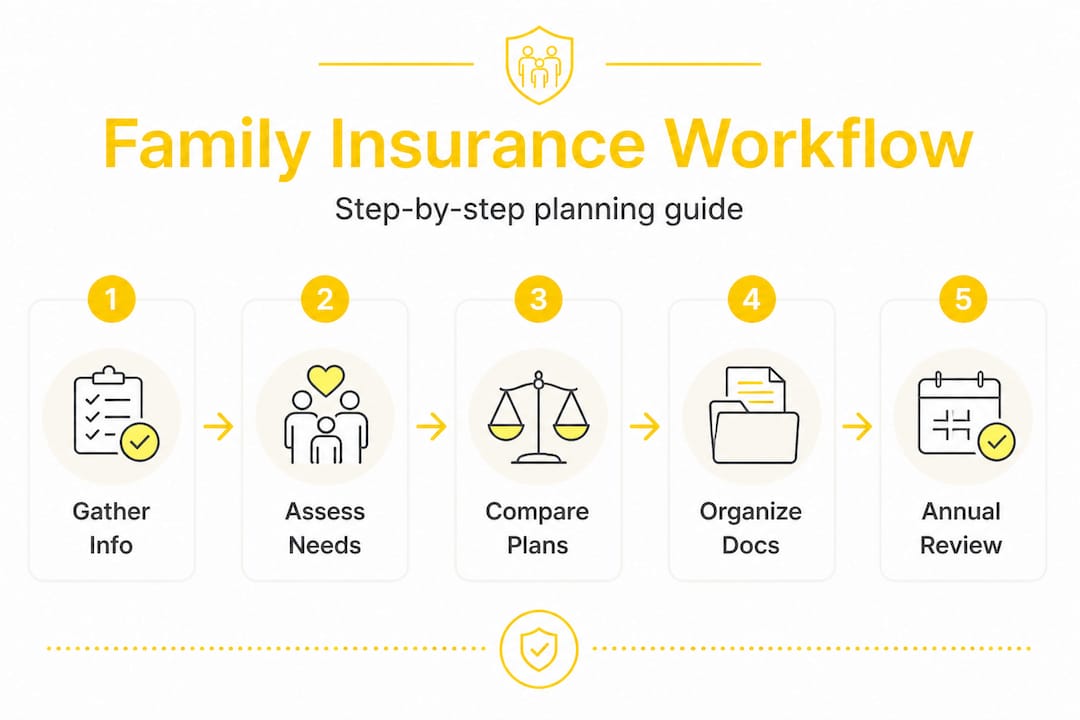
Once you have your information in order, you’re ready to follow a workflow that covers every critical insurance planning step. Moving through these stages in sequence ensures nothing gets skipped, and it makes your annual review much faster after the first year.
The six-step workflow
Inventory all current coverage. List every active policy, the insurer, the coverage amount, the premium, and the renewal date. This creates your baseline and reveals any obvious gaps or overlaps immediately.
Identify coverage gaps. Compare your current coverage totals against your family’s actual needs. Are you carrying group life insurance equal to just one or two times your salary? That’s almost certainly not enough if you have a mortgage and young children.
Apply the DIME method for life insurance. Using the numbers you collected, add your debts, income replacement figure, mortgage balance, and education estimate. The DIME formula gives you a specific dollar target that reflects your household’s real obligations rather than a rough guess.
Evaluate your health plan thoroughly. Confirm that your primary doctors, specialists, and preferred hospital are in-network. Then model a worst-case scenario: if your family hits the out-of-pocket maximum, can your budget absorb that cost? Cheap premiums can translate into expensive utilization costs when you factor in deductibles and out-of-network exposure. Understanding group vs. individual plans also helps you decide whether employer coverage or a marketplace plan better fits your family’s usage patterns.
Update beneficiaries on all policies. This step is skipped more often than any other. A life insurance payout goes to whoever is named, regardless of what your will says. Confirm that primary and contingent (backup) beneficiaries are listed correctly on every life insurance policy, retirement account, and annuity.
Build in an annual review. Mark it on the calendar. Treat it as a non-negotiable financial task, much like filing taxes. Life changes, coverage needs change, and premiums fluctuate.
DIME vs. income multiplier: a side-by-side comparison
Method | How it works | Pros | Cons | Best for |
DIME worksheet | Adds four specific financial categories | Precise, reflects real obligations | Takes time to calculate | Families with mortgages, debts, or education costs |
Income multiplier (10x rule) | Multiplies annual salary by a fixed number | Quick and simple | Often underestimates complex households | Single earners with minimal debt |
The income multiplier is a starting point, not a plan. Learning why buy life insurance goes beyond the calculation itself, helping you understand the protection philosophy that drives smart coverage decisions. For thorough planning, you also want to review the broader insurance safeguards your family should have in place.
Common mistakes to avoid during this workflow
Skipping the beneficiary review, especially after a divorce, remarriage, or the birth of a child
Selecting a health plan based on the monthly premium alone, without modeling actual out-of-pocket scenarios
Underestimating disability risk; statistically, you are far more likely to experience a disability than an early death during your working years
Forgetting to account for a stay-at-home parent’s replacement cost in the life insurance calculation
Warning: The plan with the lowest monthly premium is rarely the lowest-cost plan when a real health event occurs. A $200 monthly savings can evaporate instantly when a high deductible kicks in or a specialist turns out to be out-of-network. Always compare total annual exposure, not just the premium line.
Troubleshooting and avoiding common mistakes
With a workflow in hand, it’s wise to know which traps catch families off guard the most. Even families who set up a solid plan at one point often let it drift out of alignment as life changes.
Here are the most common pitfalls and how to avoid them:
Missing annual reviews. Insurance needs shift every year. A raise, a new child, a refinanced mortgage, or a job change can all make last year’s plan obsolete.
Ignoring life event triggers. Marriage, divorce, the birth of a child, a parent moving in, or a child leaving for college are all signals to revisit coverage immediately, not at next year’s review.
Focusing exclusively on price. As mentioned, provider network alignment and out-of-pocket maximums matter just as much as the premium. A plan that keeps your family’s doctors in-network saves real money over the year.
Ignoring disability insurance. Many families carry strong life coverage but have little or no short-term or long-term disability protection. If the primary earner is injured and can’t work for six months, how does your household cover the mortgage?
Not reviewing employer plan changes. Employers can and do change benefit packages during open enrollment. What was in-network or fully covered last year may not be this year. Always read the annual open enrollment materials carefully instead of defaulting to the same elections.
Keeping paper-only records in unsecured places. If your only copy of a life insurance policy is in a filing cabinet that a grieving family member can’t locate, it creates unnecessary delays in filing a claim.
You can sharpen your ability to evaluate coverage quality by learning how to compare insurance policies side by side, which is especially useful when switching employers or shopping for supplemental coverage.

Pro Tip: Tie your insurance review to a predictable calendar event. Open enrollment season in the fall is a natural trigger. So is your tax filing appointment in the spring, since your accountant already has your income and debt information on hand. Pairing the review to an existing habit makes it stick.
What most families miss about insurance planning
Here’s something most financial content won’t tell you plainly: the biggest threat to your family’s financial security is not having “too much” or “too little” insurance in general. It’s having the wrong mix of coverage for where your family actually is right now.
Standard advice treats insurance planning as a one-time setup task. Buy a policy, check the box, move on. But families are not static. A couple in their late twenties buying their first home has completely different exposure than that same couple a decade later with two kids in school, aging parents, and a growing retirement balance. The plan that fit perfectly at year one can leave serious holes by year eight.
The DIME method is valuable, but use it as a framework, not a fixed answer. It doesn’t account for a business you might own, special needs in the family, or the fact that income replacement needs shift as kids grow up and leave home. Revisit your numbers every two or three years, not just when something bad happens.
We also believe strongly in the value of open family conversations about insurance. Most households treat the topic as too morbid or too complicated to discuss. That silence is actually the biggest risk. When your family understands what’s in place and why, they’re far better equipped to navigate a crisis without making rushed decisions. Life insurance for families is ultimately about making sure the people you love have clarity and stability at the moment they need it most.
Expert guidance makes all the difference
Following a structured workflow puts you well ahead of most families. But having a knowledgeable professional review your plan adds a layer of confidence that no checklist alone can provide.

At Strawderman Financial, our agents specialize in helping families find the right combination of coverage without the confusion. Whether you’re starting from scratch, filling a coverage gap, or reviewing what you already have, we offer free consultation sessions that give you a clear picture of where you stand. Explore your family financial planning options or take a closer look at how to explore life insurance options built specifically for families like yours. We make the process straightforward, personal, and genuinely focused on your household’s long-term security.
Frequently asked questions
What is the DIME method for calculating life insurance?
The DIME method adds Debts, Income replacement, Mortgage balance, and Education expenses together to produce a specific life insurance coverage target tailored to your family’s real financial obligations.
How often should my family review our insurance plan?
Review your coverage at least once a year, and immediately after any major life event such as a birth, a job change, a move, a marriage, or a divorce.
Does the lowest monthly premium mean the best health plan?
Not always. As families should know, a low premium can lead to much higher total costs if your deductible is steep or your preferred providers are out-of-network.
What documents should I keep for insurance planning?
Keep all current policy documents, declaration pages, the latest billing statements, beneficiary designation forms, and secure login credentials in one organized digital or physical location that a trusted family member can access.
Recommended


Comments