
What Is Health Insurance? Your Guide to Smart Coverage

TL;DR:
Despite high US healthcare spending, many families remain confused about insurance costs and coverage.
Health insurance involves paying premiums, deductibles, copays, and coinsurance, with specific coverage details.
Choosing the right plan requires understanding costs, network types, and aligning coverage with your needs and budget.
Americans spend more on health care than any other country on earth, yet millions of us still feel lost when it comes to understanding how health insurance actually works. If you’ve ever stared at an Explanation of Benefits and felt completely confused, you’re not alone. The US health spending is the highest globally, yet coverage gaps and confusing terminology leave many families making costly mistakes. This guide breaks down the basics of health insurance, explains the mechanics that shape your real costs, and gives you practical tools to make smarter choices for your family’s financial future.
Table of Contents
Key Takeaways
Point | Details |
Essential protection | Health insurance shields you from unpredictable, high medical costs. |
Know the costs | Understanding premiums, deductibles, and out-of-pocket limits is critical for budgeting. |
Plan choice matters | Different types of plans fit different life stages, jobs, and health needs. |
Watch for changes | Be aware of trends in premiums, subsidies, and coverage rules each year. |
Expert help available | Professional guidance makes choosing and managing insurance less stressful. |
What is health insurance?
At its core, health insurance is a financial agreement. You pay a regular fee, and in exchange, an insurer helps cover your medical costs when you need care. Think of it like a safety net: you hope you never fall, but you’re very glad it’s there when you do.
In the United States, the health insurance overview shows a system where private insurers, employers, and government programs like Medicare, Medicaid, and ACA Marketplace plans cover medical expenses for individuals and families. This means your coverage could come from several different sources depending on your age, income, and employment status.
Here’s what most standard health insurance plans cover:
Doctor visits and specialist appointments
Hospital stays and emergency care
Prescription medications
Preventive services like vaccines and annual checkups
Mental health and substance use treatment (required under the ACA)
Maternity and newborn care
What plans typically do not cover includes cosmetic procedures, most dental and vision care (unless you add supplemental coverage), and experimental treatments.
One of the biggest misconceptions we hear from families is that health insurance only matters if you’re sick or injured. That’s simply not true. A single emergency room visit can cost thousands of dollars. A hospital stay can wipe out years of savings. Understanding insurance safeguards is about protecting your family from the unexpected, not just managing chronic illness.
“Health insurance is not a luxury. It is one of the most powerful tools a family has to protect its financial stability.”
Pro Tip: Even if you’re young and healthy, having coverage protects you from the financial devastation of an unexpected accident or diagnosis. The cost of going uninsured can far exceed the cost of a monthly premium.
Think of protecting your family’s finances as a full picture. Health insurance is one essential piece of that picture.
How health insurance works: Key mechanics explained
Knowing what health insurance is only gets you so far. The real confusion starts when you try to figure out what you’ll actually pay. Let’s walk through the five key cost components you’ll encounter.
Term | Definition | Typical 2026 Amount |
Premium | Monthly fee to keep coverage active | $450 to $600/month (individual) |
Deductible | Amount you pay before insurance kicks in | $1,500 to $3,000/year |
Copay | Fixed fee per visit or service | $20 to $50 per visit |
Coinsurance | Your share after the deductible is met | 20% to 30% of costs |
Out-of-pocket max | Most you’ll pay in a year before insurance covers 100% | $8,000 to $9,200 (individual) |
According to average cost benchmarks, these figures reflect the typical range for 2026 marketplace and employer plans.
Here’s how a typical billing process flows from start to finish:
You visit a doctor. The provider submits a claim to your insurer.
The insurer reviews the claim and applies any negotiated rates.
You pay your deductible first if it hasn’t been met yet for the year.
Once the deductible is met, you pay coinsurance or copays for services.
After hitting your out-of-pocket max, your insurer pays 100% for the rest of the year.
One important note: preventive care is often covered at no cost to you under the ACA, even before your deductible is met. Annual physicals, screenings, and vaccines typically fall into this category.
Pro Tip: Always check the out-of-pocket maximum before choosing a plan. That number is your worst-case financial exposure for the year. A plan with a lower premium but a very high out-of-pocket max can actually cost you far more if you need significant care.
When comparing insurance policies, look at the full cost picture, not just the monthly premium. The coverage statistics show that families who focus only on premiums often face larger bills when they actually use their coverage.

Types of health insurance plans
Not all health insurance is the same, and the right plan for you depends heavily on your age, income, employment, and health needs. Here’s a side-by-side look at the major options available to Americans.
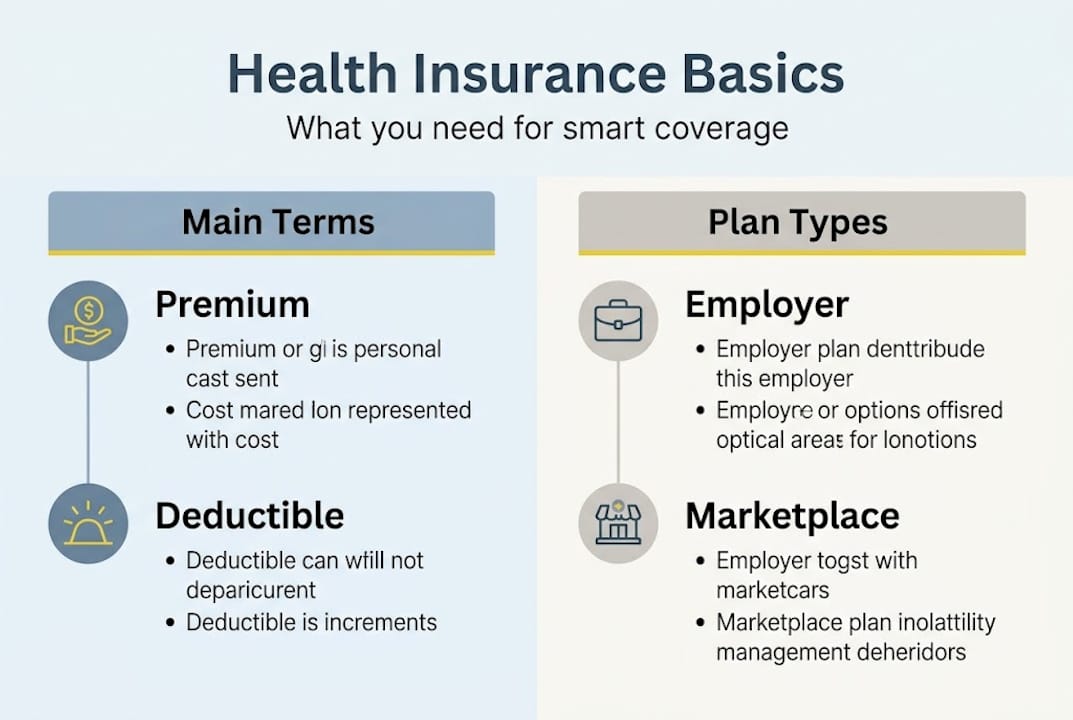
Plan Type | Who It’s For | Key Benefit | Potential Drawback |
Employer-sponsored | Working adults and dependents | Often subsidized by employer | Limited to employer’s options |
Medicare | Adults 65+ or certain disabilities | Comprehensive federal coverage | Complex rules, some gaps |
Medicaid | Low-income individuals and families | Low or no cost | Provider availability varies |
ACA Marketplace | Individuals without employer coverage | Subsidies available | Premiums vary by income |
Private insurance | Anyone, especially self-employed | Flexibility and choice | Can be expensive without subsidy |
In 2024, 92% of Americans had some form of health coverage, a record high, but that still leaves millions uninsured or underinsured.
Some key situations where your options change include:
Losing a job triggers a Special Enrollment Period (SEP) for the ACA Marketplace
Turning 65 means transitioning to Medicare, which has specific coordination rules if you still have employer coverage at 65
COBRA lets you keep your employer plan temporarily after leaving a job, but you pay the full premium yourself
Income changes can affect your Medicaid eligibility or ACA subsidy amount mid-year
For a deeper look at your specific options, our comprehensive guide to insurance types walks through each plan type in detail. Your life stage really does change which option makes the most financial sense.
Challenges and trends: Costs, gaps, and opportunities
Even with record coverage rates, health insurance affordability remains a serious concern for American families. Premiums and deductibles have been rising faster than wages for years, and that gap is squeezing household budgets.
“The US spends more per person on health care than any other high-income country, yet does not offer universal coverage. That gap falls hardest on middle-income families who earn too much for Medicaid but too little to absorb high premiums.”
A striking 37% of insured Americans worry about affording care in 2026, even with coverage. That number tells you something important: having insurance is not the same as having affordable access to care.
Some of the biggest challenges families face today include subsidy cliffs, where earning slightly more can cause you to lose significant financial assistance. People with pre-existing conditions also face unique pressures when navigating plan options, even with ACA protections in place.
Here are actionable strategies to manage your health insurance costs:
Use a Health Savings Account (HSA) if you’re enrolled in a high-deductible health plan. Contributions are tax-free, grow tax-free, and withdrawals for medical expenses are also tax-free.
Understand HMO vs PPO networks. HMOs are cheaper but restrict you to a network. PPOs cost more but give you flexibility to see out-of-network providers.
Time your coverage purchases carefully. Open Enrollment runs from November 1 to January 15 for most ACA plans.
Check your subsidy eligibility every year. Income changes can open or close subsidy options that significantly affect your costs.
Use preventive care benefits fully. These are free under most ACA plans and can catch problems before they become expensive.
Pro Tip: When comparing plans, put the premium and out-of-pocket maximum side by side. A plan with a $200 lower monthly premium but a $3,000 higher out-of-pocket max is only a better deal if you rarely use your coverage.
An honest perspective: What most guides miss about health insurance in America
Here’s something most articles won’t tell you: the word “coverage” is doing a lot of heavy lifting in American health insurance conversations, and it’s often misleading. Having coverage does not mean you have affordable access to quality care. It means you have a contract. What matters is the details inside that contract.
We’ve seen families pick the cheapest plan available, only to discover their preferred doctors are out of network or that a critical medication isn’t on the formulary. That’s a painful and expensive lesson.
The contrarian insight we’d share is this: a high-deductible health plan paired with a well-funded HSA is not just a cost-cutting move. Used wisely, it’s a long-term wealth-building strategy. Your HSA balance rolls over every year, invests like a retirement account, and can be used tax-free for medical costs in retirement, when healthcare spending typically peaks.
Our hard-won lesson after working with families across the country is simple: invest the time upfront to read the insurance types explained details of any plan before you enroll. The billing surprise you avoid is worth every minute.
How Strawderman Financial can help you navigate health insurance
Health insurance decisions are genuinely complex, and the stakes are too high to guess. At Strawderman Financial, we work with individuals and families across the United States to cut through the confusion and find coverage that actually fits your life and budget.

Our health insurance advisors offer free consultations to help you compare plans, understand your subsidy options, and avoid the costly mistakes that come from choosing based on price alone. Whether you’re evaluating your first plan, switching coverage, or thinking about how health insurance fits alongside your life insurance options and retirement strategy, we’re here to help. Reach out today to schedule your free coverage review.
Frequently asked questions
What does health insurance typically cover?
Most plans cover hospitalizations, doctor visits, preventive care, prescription drugs, and sometimes mental health or maternity, but coverage details vary by plan and insurer.
How do premiums and deductibles work together?
You pay a premium each month to keep your coverage active, and you must also meet your annual deductible before your plan pays for most services, as explained in key mechanics.
What are special enrollment periods (SEPs)?
SEPs let you sign up for coverage outside of Open Enrollment if you lose coverage, move, or experience a qualifying life event. In 2026, stricter verification rules apply to many SEP applications.
Does health insurance cover pre-existing conditions?
Yes. Under the ACA, pre-existing conditions cannot be used to deny you coverage or charge you higher rates for most plan types available today.
How can I lower my health insurance costs?
Using HSAs, carefully comparing plan networks, and fully using your preventive care benefits are among the most effective strategies, according to affordability research on how insured Americans manage expenses.
Recommended

Comments